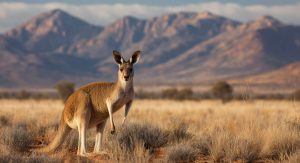
Kathryn Bugler, a PhD student at the University of Adelaide, has been provided a grant to assist in her PhD project involving the red kangaroos. The grant will be used to investigate the movement and behaviour of wild red kangaroos.
Project Summary
This project will pioneer the use of GPS and accelerometer tracking to investigate the movement and behaviour of wild red kangaroos (Osphranter rufus), aiming to inform practical management strategies across Australia’s rangelands. We will collar 60 individuals and conduct targeted field experiments on water availability and fencing. Our work will directly contribute to ecological understanding, animal welfare, land management, and human-wildlife conflict resolution between pastoral and conservation sectors, while also providing insights for sustainable wildlife use.
Our aim is to use tracking data to inform evidence-based kangaroo management by:
• Generate the first high-resolution movement and behavioural dataset for red kangaroos.
• Determine how kangaroos use and move between conservation and pastoral lands.
• Investigate how quickly kangaroos discover and use new artificial water points.
• Examine interactions with fences and assess the effects of fence removal on movement patterns.
• Identify behavioural indicators of drought-induced stress.
Background and Rationale
Australia’s red kangaroo is an iconic species, playing a critical ecological and cultural role in the rangelands. However, overpopulation of kangaroos has become an increasing problem, especially in the arid regions, where the species’ impact on fragile ecosystems is being felt. As a result of periodic booms in population following rainfall, kangaroos can overgraze vegetation, trample important habitat, and damage infrastructure in pastoral areas. Such population cycles were historically moderated by predators and water availability (James et al., 1998). However, widespread dingo control and the proliferation of artificial water points have disrupted this balance (Fensham & Fairfax, 2008). Additionally, during droughts, kangaroos are subjected to welfare issues, including malnutrition and high mortality rates, causing distress for landholders and conservationists alike. In some instances, pastoralists are forced to make difficult decisions about culling or other management interventions.
These population pressures have also increased reliance on commercial kangaroo harvesting as a management tool, yet current quota-setting frameworks lack fine-scale behavioural and movement data to ensure sustainability (DEW, 2025). Despite these efforts, only a fraction of quotas are being met, and overpopulation remains a persistent challenge.
While kangaroos play a vital role in the ecosystem, understanding how their populations impact the environment, particularly in relation to infrastructure and threatened species, is poorly understood. This project addresses that gap by combining cutting-edge GPS tracking and accelerometer technology to study the movement and behaviour of wild red kangaroos. Existing movement data comes from VHF studies conducted in the 1980s-90s, which suffer significant limitations due to poor signal quality and triangulation issues (Croft, 1991; Priddel et al., 1988). Modern GPS and accelerometer technology now enables high-resolution data capture, yet only two GPS studies exist (Cowan et al., 2020; Henderson et al., 2018), and both on grey kangaroos. No accelerometer-based behavioural research has been published for kangaroos.
Our study will deploy GPS/accelerometer collars on wild red kangaroos to gather unprecedented movement and behaviour data, updating knowledge on home range size and travel distances. This research is particularly crucial as Australia’s climate continues to fluctuate with greater extremes, causing challenges for both conservation and agriculture. By investigating how kangaroos interact with environmental features like artificial water points, fences, and pasture areas, we aim to inform strategies that minimise ecological damage, improve welfare, and support sustainable management.
Methods
The study will occur at two sites in South Australia: Cleland Wildlife Park and Bon Bon Station Reserve. Ethics has been granted by the University of Adelaide animal ethics committee and a research permit by DEW.
1) Behavioural classifier development: To interpret accelerometer data, we will first develop a behavioural classifier using five captive individuals at Cleland Wildlife Park. Over three weeks, structured observations of behaviours (e.g., resting, drinking, hopping, grazing) will be time-stamped and aligned with accelerometer outputs to build a machine-learning model for wild individuals.
2) Wild kangaroo tracking: At Bon Bon Station, collars will be fitted on up to 60 wild red kangaroos for up to 12 months, generating large, high-resolution movement and behaviour datasets. Kangaroos are darted at night under a spotlight, with Zoletil, monitored until sedated, then process on a foam mattress for collar fitting and measurements. They are left alone to recover, with individuals rechecked within 48hours to ensure welfare.
3) Movement between properties and water-use We will track movements between Bon Bon and neighbouring properties to assess frequency, duration, and destinations, including attraction to artificial water points or grazing areas. Temporary water points will be introduced at Bon Bon. GPS data and trail cameras will monitor how quickly kangaroos locate these points and how information spreads through the population.
Opportunistic experiments will also occur, such as monitoring responses when neighbouring properties turn off troughs, already being visited by collared individuals. This will reveal whether kangaroos move directionally to the next closest water source or explore broadly, and how quickly they return once water is restored.
4) Fence interaction and movement analysis: Tracking data will be analysed to understand interactions with existing pastoral fences. A BACI experiment will assess changes in movement patterns following fence removal, informing layouts that balance infrastructure protection with wildlife permeability. Bush Heritage volunteers will assist with removing selected fences along well-used paths and areas, with GPS and accelerometer data being used to compare before and after removal.
5) Drought/extreme weather behaviour monitoring If drought occurs, accelerometer data will be analysed for behavioural indicators of physiological stress, such as prolonged resting or reduced activity, providing early-warning indicators of potential mass mortality events. Conversely, heavy rainfall will allow us to
capture behavioural responses to extreme wet conditions, expanding insights across climatic extremes.
Stakeholder Engagement
This project is conducted in collaboration with and supported by Bush Heritage Australia (BHA), who provide access to field sites, provision of ecological resources, field accommodation and equipment for kangaroo capture and collar deployment. BHA also contributes foundational funding and offers extensive local knowledge and practical experience in managing arid rangelands to guide study design and implementation. Furthermore, BHA’s established network among landowners, government agencies, and conservation organisations will facilitate the effective distribution of research outcomes, beyond the immediate study area.
This project is a PhD project through the University of Adelaide and is not in direct collaboration with traditional owners. However, through BHA, the project has been discussed with their Aboriginal Partnerships Manager and an invite extended for local traditional owners to accompany field activities. Bon Bon has traditional owners living on country, increasing opportunities for collaboration and engagement.
Scientific Contributions
This project will deliver the first comprehensive behavioural dataset for red kangaroos using GPS and accelerometers, providing insights into how kangaroos navigate fragmented landscapes, respond to human-made structures and resource availability. This data could also be used to underpin adaptive harvest models and quota-setting frameworks, ensuring management decisions are grounded in robust ecological evidence.
Management Applications: Findings will inform evidence-based strategies for water point management to reduce grazing pressure alongside fence design recommendations that minimise structural damage while supporting wildlife movement. We will also identify humane management triggers during drought events, supporting early intervention and reducing mass mortality.
Wider Impacts: Beyond ecological and management outcomes, this research will foster collaboration between conservation organisations and pastoralists through transparent, data-driven findings. It will improve animal welfare outcomes during climatic extremes and contribute to national efforts to balance biodiversity conservation with sustainable land use.